What I'm working from right now for a tourism poster for coffee shops in SF.
Ideas, Changes & Alterations -
turn map in b/w
add chart under map, of shops and traits of shops (wifi, bike racks, large seating, cafe/baked food)
Change shop location marks(no shop name, change red dot to coffee cup illustration icon)
Make map larger & move more to center
Tuesday, April 23, 2013
Thursday, March 21, 2013
Art/Mapping
Duo Label Antivj - Installation by Joanie Lemercier
EYJAFJALLAJĂ–KULL from ANTIVJ is a visual label on Vimeo.
Debug - Art made by InsectsDebug - Art made by insects from Edhv on Vimeo.
Wind Map "An invisible, ancient source of energy surrounds us—energy that powered the first explorations of the world, and that may be a key to the future. This map shows you the delicate tracery of wind flowing over the US. "Tuesday, March 5, 2013
Virtual Intervention
In designing a virtual intervention of our location we strived to look at this public space in many different ways. By using several tools from online mapping sources, mobile applications, video, and photos, we attempted to completely immerse the viewer in the virtual space in an attempt to mimic physical reality. On Thursdays this public space turns into a farmers market that students and the neighbors enjoy. Our gallery of collected media can be used to visually explore this space and experience the sights and sounds completely online.
We placed a QR code at the location with a label asking those that passed by to kindly scan the matrix barcode. When they scanned the code, they were brought to this page and below is the response we received from those that participated.
Our Location: SFSU Campus, Between Fine Arts and Humanities Building
37°43'19.70"N
122°28'49.60"W

We placed a QR code at the location with a label asking those that passed by to kindly scan the matrix barcode. When they scanned the code, they were brought to this page and below is the response we received from those that participated.
- "Humanities building at sfsu"
February 28, 2013 at 10:01 PM
- "Thursday February 28th, 2013. 11:49 it’s foggy here on campus, the lights glow with an orange tint as I walk past this sign. It’s cold. An eerie fog blankets the humanities building and motor bike drives by... I’m glad I don’t have class tomorrow."
February 28, 2013 at 11:52 PM
- "Cold and gloomy"
February 28, 2013 at 1:32 PM
Tuesday, February 19, 2013
Chance Operation; Bouncy Balls paint Box
For our chance operation system we wanted to make a system that would produce a visual piece of work using paint as the primary medium.
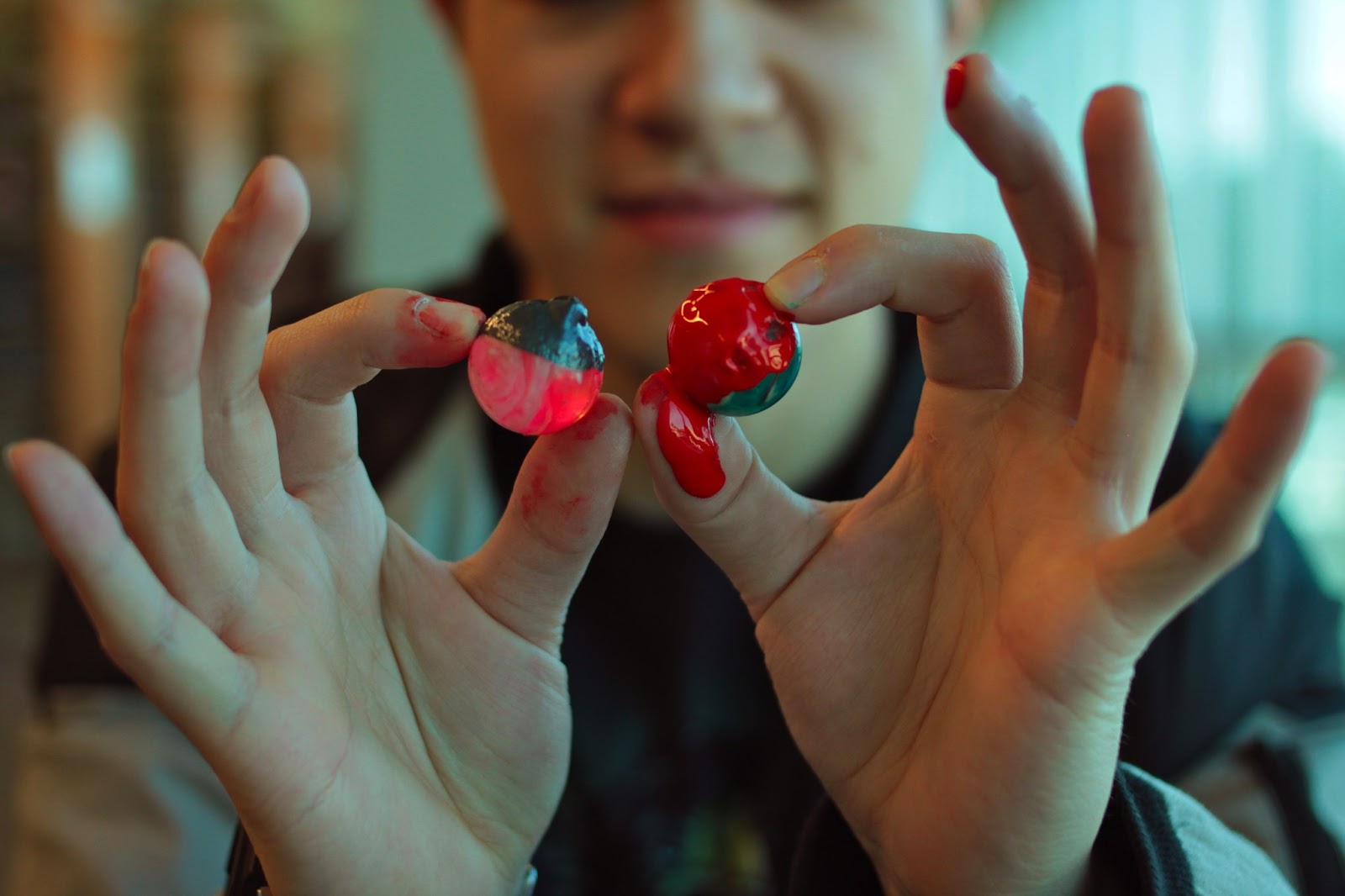
What we began developing was a constructed cube that we would drop in bouncy balls that were dipped in paint and then shake the cube and see what would result.
Materials:
1. Six 3"x3" white foam board pieces
2. Two small bouncy balls
3. red paint & black paint
4. tape
5. Dice
Procedure:
1. Assemble a cube with foam board, and cut a small flap on the top side to drop in the bouncy balls. Tape together the sides to make the cube.
2. On the top left corners of each side write a number 1-6, with a directional arrow 'up', which would designate in what order and direction to lay down the sides when done.
3. Roll a pair of dice to get a random number of minutes for how long to shake balls in the cube.
We landed on 4, so would shook the cube 4 minutes.
4. Dip each ball half way in paint, one in black paint, and the other in red paint.
5. Drop the balls in the cube through the flap on the top and shake the cube (we shook ours 4 minutes).
6. Take apart the cube, lay sides in order and direction according to labels on top left corner.
See the result.
Take a closer look;
Front side of cube / 1
Right side of cube / 2
Back side of cube / 3
Left side of cube / 4
Bottom side of cube / 5
Top side of cube with flap / 6
What we began developing was a constructed cube that we would drop in bouncy balls that were dipped in paint and then shake the cube and see what would result.
Materials:
1. Six 3"x3" white foam board pieces
2. Two small bouncy balls
3. red paint & black paint
4. tape
5. Dice
Procedure:
1. Assemble a cube with foam board, and cut a small flap on the top side to drop in the bouncy balls. Tape together the sides to make the cube.
2. On the top left corners of each side write a number 1-6, with a directional arrow 'up', which would designate in what order and direction to lay down the sides when done.
3. Roll a pair of dice to get a random number of minutes for how long to shake balls in the cube.
We landed on 4, so would shook the cube 4 minutes.
4. Dip each ball half way in paint, one in black paint, and the other in red paint.
5. Drop the balls in the cube through the flap on the top and shake the cube (we shook ours 4 minutes).
6. Take apart the cube, lay sides in order and direction according to labels on top left corner.
See the result.
Take a closer look;
Front side of cube / 1
Right side of cube / 2
Back side of cube / 3
Left side of cube / 4
Bottom side of cube / 5
Top side of cube with flap / 6
Thursday, February 14, 2013
'As We May Think' - Vannevar Bush, thoughts & predictions
TBC
3 predictions of future technologies and tools to be used within the next 60 years include;
~ Hologram - live time/pre-recorded, use also in digital visuals (image recording)
~ Fluorescent plants ( more genetically modified) - use as light source at nigh ( or day), change in environmental importance - use resources without exploiting.
Organic fluorescent processes used to replace electricity (household items).
~
Ideas for Chance Operations - With Paint
1. Fan paint;
Hang blank drawing paper on a wall,
Set strings across(3), in front of the paper, Each string has 5 small pieces of paper on then (clothespins),
Each small paper has a dab of paint (red),
Set fan in front of stings, roll dice to determine how long to keep the fan on. (add for minutes)
Result - color image.
2. Dice paint;
Get a number of dice, dip in paint (red), roll dice on blank drawing paper
Result - color image.
3. Blind folded hand paint;
Black paper hung on wall, 4 buckets with paint inside - rubber lid (cross cut, can stick hand through but can't see what color)
First partner is blind folded
Cont.
4. Dice in the Box...
Hang blank drawing paper on a wall,
Set strings across(3), in front of the paper, Each string has 5 small pieces of paper on then (clothespins),
Each small paper has a dab of paint (red),
Set fan in front of stings, roll dice to determine how long to keep the fan on. (add for minutes)
Result - color image.
2. Dice paint;
Get a number of dice, dip in paint (red), roll dice on blank drawing paper
Result - color image.
3. Blind folded hand paint;
Black paper hung on wall, 4 buckets with paint inside - rubber lid (cross cut, can stick hand through but can't see what color)
First partner is blind folded
Cont.
4. Dice in the Box...
Tuesday, February 5, 2013
speed brain dump - class exercise
ideas/thoughts -
2.5.13;
natural textures, visually similar. physically different
organic colors, visually similar. physically different
motion sensor to trigger real experience
looping visuals
contrasting visuals & sounds
ambiguous visuals
multifunctional house items, ID
2.5.13;
natural textures, visually similar. physically different
organic colors, visually similar. physically different
motion sensor to trigger real experience
looping visuals
contrasting visuals & sounds
ambiguous visuals
multifunctional house items, ID
Subscribe to:
Posts (Atom)